
Before we discuss how to apply for RERA registration in India, let us understand how and why RERA registration is so crucial if you are in the real estate business. We will learn the step-by-step RERA registration process, documents you need, and the state-wise RERA registration guides.
If you are a developer, promoter, or real estate professional, this AAJneeti blog post is a must-read for you.
Why do People Prefer RERA-Registered Projects in India?

RERA or the Real Estate (Regulation and Development) Act, 2016, was enacted to bring more transparency and accountability to the real estate sector and make it more organised. The need for it was being sorely felt in the industry because a lot of wrong practices were rampant before that. Builders and developers were sharing misleading information with the prospective buyers and investors, delayed possessions were common, and many developers were diverting project funds to launch new projects (which used to impact the construction and delivery timelines of their previous projects).
RERA revolutionised how the industry works. People today are actively choosing RERA-registered projects, and here’s why:
1. Transparency in Information
Developers are required to disclose complete project information on the state RERA portal. These include details like:
- Land title details and status
- Approved layout and building plans
- Construction timelines and expected possession date
- Number of units and their configuration (along with their exact carpet area)
- Details of various approvals from government authorities
- Construction progress updates
A buyer or investor can check the RERA portal and verify everything.
2. Buyer Funds Stay Protected
When a developer registers a project with data, they have to deposit at least 70% of the project funds collected from the buyers and investors into a separate escrow account. This money can only be used to cover land costs or construction for that specific project. Thus, the risk of money being diverted into another project is greatly reduced.
3. Greater Commitment to Possession Timelines
RERA-registered projects need to declare possession timelines clearly. If they get delayed, buyers are entitled to compensation or interest. That gives buyers a sense of security that non-RERA-registered projects don’t offer.
4. Carpet Area is Clearly Defined
Earlier, builders used to mention ‘Super Built-Up Area’ and used a lot of terms to advertise inflated spaces to buyers. The term ‘Carpet Area’ was also used loosely. RERA makes it mandatory to clearly mention the carpet area according to its standardised definition the usable area within the apartment.
The clarity helps people to trust these projects better.
5. Better Legal Protection for Buyers
The RERA authority offers greater protection and quicker resolution to buyers than traditional legal routes. If a buyer faces issues with the construction quality, delays, or wrong info being shared, they can file a complaint with the authority. RERA offers faster and more structured ways to deal with such complaints.
6. Developers are More Accountable
Developers are also required to submit Quarterly Progress Reports (QPRs) where they share information like:
- Construction progress of each building or phase with photographic evidence
- Number of units booked or sold
- Updated approvals and permits
- How are funds in the Project Escrow Account being used every three months.
Developers also have to submit annual financial audit reports, Completion Certificate or Occupancy Certificate approvals, changes in project timelines or plans if any, and project extension approvals if any.
If developers fail to submit or update the required info, they attract notices from the RERA authority, penalties and fines, and even suspension of project registration in serious cases.
These are some of the biggest reasons why buyers and investors check the RERA number of a project first before putting their money in it.
Who Needs to Apply for RERA Registration in India?
The RERA Act primarily covers real estate developers (promoters) and real estate agents. All the stakeholders in the real estate sector need to register with the respective State RERA authority before marketing and selling properties or facilitating property transactions. There are certain exceptions though.
Before discussing how to apply for RERA in India, let us discuss who needs to register for it and who is exempted.
A developer must apply for RERA registration if:
- The project area is more than 500 square meters.
- The project has more than 8 apartments or units.
- The project is a plotted development, residential project, commercial project, or mixed-use project.
All those projects that were ongoing in 2016 or have been launched after that (falling into the above categories) must be registered with RERA.
So, we can say that smaller projects with less than 500 sq m in size and less than 8 apartments or units, as well as, projects that received their Completion Certificates before the RERA Act came into force are exempted from RERA registration.
Projects undergoing renovation, redevelopment, or repair work do not need to apply for RERA.
Some government housing and redevelopment projects also receive exemptions from RERA registrations according to the nature of the project and the state where they are located.
Also, if someone is building a project for their personal use and is not marketing or selling it, they do not need to register it with RERA.
Real estate agents, channel partners, brokers, and property consultants who facilitate transactions in RERA-registered projects also need to apply for RERA registration from the respective state authority, whether they are working as individuals or a company.
All brokerage firms and real estate marketing companies need to be registered with RERA to legally advertise, sell, or facilitate transactions in RERA-registered projects.
Let us make one thing clear here. AAJneeti does not need RERA registration to run Meta ads or Google Ads and real estate lead generation for a project. We do not act as a broker, channel partner, or a sales intermediary earning commissions from transactions.
Once registered, agents or brokers or property consultants must maintain a proper record of transactions they do or facilitate. They are also required to follow fair trade practices while dealing with developers or buyers.
If a landowner partners with the builder for a Joint Development Project, they need to register with RERA as a promoter too (along with the developer).
Existing projects who had not received a Completion Certificate until 2016 when RERA came into force were required to register too to protect buyers who had already invested in it. Similarly, gated plotted communities, residential plot developments, and township developments with sizes more than 500 sq m are required to register with State RERA too (as discussed above).
What Does the RERA Registration Process Look Like?
The overall apply for RERA registration process is similar all over India. These include:
Step 1: Project Preparation
Before applying for RERA, a developer must ensure that all the required project details are ready with them.
Step 2: Create an Account on the State RERA Portal
Register on the official portal of the respective State RERA authority and create a Promoter login.
Step 3: Fill the RERA Project Registration Application
Fill all the required details, such as Location, Type of Development, Unit Configuration, Project Completion Deadline, and more.
Step 4: Submit the Required Project Details and Documentation
Apart from the details, developers also need to submit all the documents related to the project during the application process.
Step 5: Pay RERA Registration Fee
RERA Registration Fee is determined by the project type and size. It can be paid online through the portal.
Step 6: Application Review by State RERA Authority
The authority reviews the submitted application, verifies the project information developers share, and seeks clarifications (if required).
Step 7: RERA Registration Approval
If the application fulfills all regulatory requirements, the authority grants the project a unique RERA Registration Number.
Step 8: Project Listing on RERA Portal
Once the project is approved and becomes visible on the State RERA website, it can be legally advertised and marketed.
Step 9: Ongoing RERA Compliance
Developers are required to submit project updates and other regulatory updates periodically according to the RERA regulations.
Let us now see what documents are required to apply for RERA.
Documents Required to Apply for RERA Registration
The most critical factor apply for RERA registration is to submit all the required details and key documents correctly.
1. Identity and Business Registration Details of Promoter or Developer
These include:
- PAN Card of the promoter or developer
- Aadhaar Cards or Identity Proofs of individual promoters
- Certificate of Incorporation (for companies)
- LLP Agreement or Partnership Deed (if applicable)
- Company Registration Documents issued by the Ministry of Corporate Affairs
- Address Proof of Registered Office
- Contact Details of the Authorised Signatory
2. Land Ownership and Title Documents
These include:
- Land Title Deed as Proof of Land Ownership
- Chain of Title Documents Covering the Past 30 Years (in most cases)
- Encumbrance Certificate to Confirm the Land is Free from Legal Disputes or Liabilities
- Development Agreement OR Joint Development Agreement (if developer is not the landowner)
- Consent Letter from the Landowner (if applicable)
3. Approved Project Layout and Building Plans
These include:
- Project Master Plan
- Approved Project Layout Plan
- Approved Building Plan
- Floor Plans of Apartments or Units
- Details of Common Areas and Amenities
4. Project Details and Development Information
These include:
- Project Name and Address
- Total Project Area & Land Parcel Size
- Number of Towers or Buildings Planned
- Total Number of Apartments or Commercial Units Planned
- Carpet Areas of Each Individual Unit
- Details of Parking Spaces
- Information about Common Facilities and Amenities
5. Project Schedule and Construction Timeline
These include:
- Proposed Date of Project Commencement
- Expected Date of Project Completion
- Phase-wise Development Details (if any)
6. Technical Certifications from Associated Professionals
These include:
- Architect Certificate Confirming the Approved Plans
- Structural Engineer Certificate Confirming Structural Safety
- Engineer Certificate detailing Project Specifications and Construction Cost Estimates
7. Project’s Financial Details
These include:
- Estimated Cost of Land
- Estimated Cost of Construction
- Total Project Cost
- Details of the Designated Project Bank Account
8. Promoter’s Declaration as Form B
Form B needs to be submitted as a notarised affidavit. In it, the promoter has to confirm that:
- Land Title is Legally Valid
- Project will be completed within the Declared Timeline
- Buyer Funds will not be diverted to Other Projects
- All Necessary Approves have been obtained.
9. Government Approvals and NOCs
These include:
- Environmental Clearance
- Fire Safety NOC
- Airport Authority Clearance (if applicable)
- Water Supply and Sewage Approvals
- Local Development and Authority Permissions
10. Details of Real Estate Agents or Channel Partners (If Required)
If real estate agents or channel partners are marketing the RERA-registered project, their RERA registration numbers need to be provided too.
How to Apply for RERA Registration in Different Indian States?

The overall RERA registration process largely remains the same throughout India. Three things that change are:
- State RERA Portal URL
- Registration Fee Structure
- Some Compliance Requirements and Documentation Formats

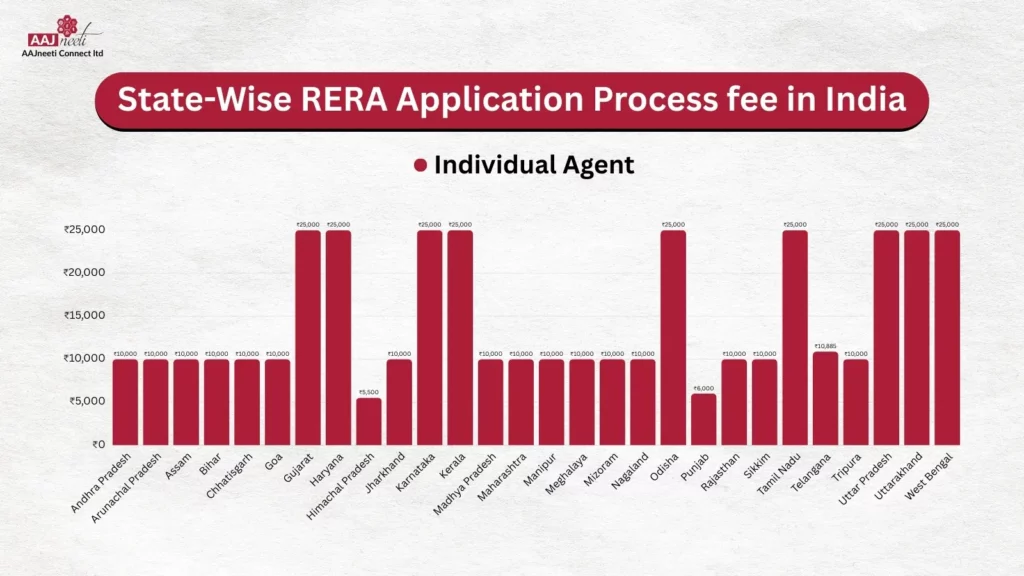
State-Wise RERA Application Process in India
| No. | State | RERA Portal | How the Application Process Differs | Typical RERA Application Fees (Approx.) for Individual Agent | Typical RERA Application Fees (Approx.) for Company |
| 1 | Andhra Pradesh | rera.ap.gov.in | This state portal has a highly structured digital project data entry format. Uploads might seem a little complicated but the process is much quicker. | ₹10,000 | ₹50,000 |
| 2 | Arunachal Pradesh | State framework evolving | It’s a smaller real estate market and the regulatory framework is still evolving. Due to customary land laws, there’s stricter verification of land ownership permissions and development rights. | ₹10,000 | ₹50,000 |
| 3 | Assam | rera.assam.gov.in | Regional land ownership structures make strict verification here too. Developers need to clearly demonstrate legal title and approvals to register their project. | ₹10,000 | ₹50,000 |
| 4 | Bihar | rera.bihar.gov.in | In this state, plotted projects and township developments undergo greater scrutiny that usually involves reviewing layout approvals and development permissions in detail. | ₹10,000 | ₹50,000 |
| 5 | Chhatisgarh | rera.cgstate.gov.in | This state emphasizes on frequent construction progress updates, unit sales, and project status. | ₹10,000 | ₹50,000 |
| 6 | Goa | rera.goa.gov.in | Second homes, holiday homes, and tourism-related projects are common in Goa. And the authority carefully reviews zoning permissions for such projects. | ₹10,000 | ₹1,00,000 |
| 7 | Gujarat | gujrera.gujarat.gov.in | Large townships and plotted developments are common here. And they require detailed disclosures. Phase-wise registrations are also common here. | ₹25,000 | ₹2,50,000 |
| 8 | Haryana | haryanarera.gov.in | Jurisdiction of the project location is crucial here. Developers need to know which RERA authority they need to register with: HRERA Gurugram or HRERA Panchkula. | ₹25,000–₹50,000 | ₹2,50,000 |
| 9 | Himachal Pradesh | hprera.nic.in | The development volumes are low here. Hence, RERA compliance structure is simpler here. | ₹5,500 | ₹20,500 |
| 10 | Jharkhand | rera.jharkhand.gov.in | Ranchi and Jamshedpur are emerging as real estate hotspots in the state. The RERA application process focuses on verifying land ownership and project approvals. | ₹10,000 | ₹50,000 |
| 11 | Karnataka | rera.karnataka.gov.in | Certifications from professionals (such as architects, engineers, and CA) are required to confirm project costs and approvals before applying for RERA. | ₹25,000 | ₹2,50,000 |
| 12 | Kerala | rera.kerala.gov.in | Detailed project specifications and construction timelines are required here. Apartment developments have relatively strict transparency requirements. | ₹25,000 | ₹2,50,000 |
| 13 | Madhya Pradesh | rera.mp.gov.in | This state portal provides detailed dashboards publicly available for buyers. Once developers register their project here, they must update project progress and sales data here regularly. | ₹10,000 | ₹50,000 |
| 14 | Maharashtra | maharera.maharashtra.gov.in | MahaRERA has one of the most advanced digital systems. Quality progress reports with photographs and financial disclosures are required after project registration. | ₹10,000 | ₹1,00,000 |
| 15 | Manipur | State implementation evolving | The state has limited real estate development activity. Hence, it receives fewer applications. Regulatory framework is still evolving. | ₹10,000 | ₹50,000 |
| 16 | Meghalaya | State framework evolving | This Northeastern state has a small real estate ecosystem. Registration procedures here are still evolving. | ₹10,000 | ₹50,000 |
| 17 | Mizoram | State framework evolving | With relatively limited real estate projects, regulatory processes are still developing here. | ₹10,000 | ₹50,000 |
| 18 | Nagaland | State framework evolving | Registration requirements exist but project volumes remain less here. | ₹10,000 | ₹50,000 |
| 19 | Odisha | rera.odisha.gov.in | Environmental approvals and project development permissions are stricter here. So, they need to be flawless for project registration. | ₹25,000 | ₹2,50,000 |
| 20 | Punjab | rera.punjab.gov.in | Developers need to disclose project approvals and land ownership clearly. Digital processing of RERA applications is relatively faster in this state. | ₹6,000–₹15,000 | ₹25,000–₹55,000 |
| 21 | Rajasthan | rera.rajasthan.gov.in | The state portal requires promoters to disclose background information and company details more comprehensively. | ₹10,000 | ₹50,000 |
| 22 | Sikkim | State framework evolving | The real estate sector here is small and RERA-registered projects are limited. So, the regulatory framework here is still evolving. | ₹10,000 | ₹50,000 |
| 23 | Tamil Nadu | rera.tn.gov.in | Developers need to secure authority and building plan approvals before applying for RERA registration | ₹25,000 | ₹50,000 |
| 24 | Telangana | rera.telangana.gov.in | Since most RERA registration here focus on large residential developments in Hyderabad, the state authority focuses on verifying project approvals and development rights. | ₹10,885 | ₹50,885 |
| 25 | Tripura | State implementation evolving | Large-scale development projects are very limited here. Hence, the state RERA regulations here are still evolving. | ₹10,000 | ₹50,000 |
| 26 | Uttar Pradesh | up-rera.in | One of the most active authorities, UP RERA requires detailed project disclosures as well as regular updates on construction progress and project approvals from developers. | ₹25,000 | ₹2,50,000 |
| 27 | Uttarakhand | rera.uk.gov.in | Many RERA registrations in this state are for hill townships or tourism-driven developments. The authority carefully reviews land use permissions here. | ₹25,000 | ₹2,50,000 |
| 28 | West Bengal | hira.wb.gov.in | The state does not follow central RERA. Instead, it follows HIRA (Housing Industry Regulation Act) but the registration process is similar. | ₹25,000 | ₹2,50,000 |
RERA Application Process in Union Territories (UTs)
| No. | Union Territory | RERA Portal | How the Application Process Differs | Typical RERA Application Fees (Approx.) for Individual Agent | Typical RERA Application Fees (Approx.) for Company |
| 1 | Andaman & Nicobar Islands | UT housing authority | Since the real estate activity here is less, RERA applications here are handled through the UT administration. | ₹10,000 | ₹50,000 |
| 2 | Chandigarh | rera.chbonline.in | The Chandigarh region’s projects are handled through an independent UT-level RERA authority. | ₹10,000 | ₹50,000 |
| 3 | Dadra & Nagar Haveli AND Daman & Diu | UT authority | Due to less number of development projects here, RERA procedures here are relatively simplified. | ₹10,000 | ₹50,000 |
| 4 | Delhi (NCT) | rera.delhi.gov.in | With dense urban development and redevelopment projects, the scrutiny of documentation in this region is quite strict. | ₹10,000 | ₹50,000 |
| 5 | Jammu & Kashmir | rera.jk.gov.in | Since this region has become recognised as a UT, a separate RERA authority has been established to regulate registered projects here. | ₹10,000 | ₹50,000 |
| 6 | Ladakh | Regional framework | The real estate ecosystem here is small and hence, its compliance structure is still evolving. | ₹10,000 | ₹50,000 |
| 7 | Lakshdweep | UT administration | This region sees very limited real estate development activity. There is no separate RERA authority here and approvals need to be sought from the Lakshadweep administration, environmental authorities, and local land regulatory authorities which are much more restrictive than the mainland states. | ₹10,000 | ₹50,000 |
| 8 | Puducherry | rera.py.gov.in | Surrounded by Tamil Nadu on most sides, Puducherry RERA’s rules, documents and approval processes are the same as Tamil Nadu RERA authority. | ₹10,000 | ₹50,000 |
At AAJneeti, we work closely with developers, real estate brands, channel partners and brokers. We plan and execute compliant real estate marketing and lead generation campaigns for them. We hope that this guide on how to apply for RERA in India will help you stay compliant while launching and promoting projects you are working with and hence, generate qualified leads through our real estate campaigns.
For a full state-by-state RERA application guide and how it can impact your lead generation campaigns and sales figures, book a consultation with our experts today.