
Building and selling property in India has never been an easy game. But the recent changes in GST on real estate, also referred to as GST 2.0 sometimes, are really squeezing the profit margins of developers across Delhi-NCR, Mumbai, and Bengaluru.
When we talk to our clients, we learn that while the market looks incredible on the surface demand is high and luxury apartments are selling out quite well, builders are struggling to protect their net profit margins. In this article, we will explore why.
At AAJneeti, we spend our days helping developers, channel partners, and brokers scale their sales funnels. We are putting this data out there because when tax frameworks quietly squeeze your margins, you cannot afford to let inventory sit idle or waste money on cold, unverified leads. Real estate lead generation and qualified leads can make a lot of difference to help your business survive and thrive in this case.
Understanding the real-world impact of today’s GST rules explains exactly why moving your inventory quickly is your best shield against tax-driven profit drains.
How GST on Real Estate Impacts Developers Balance Sheets?
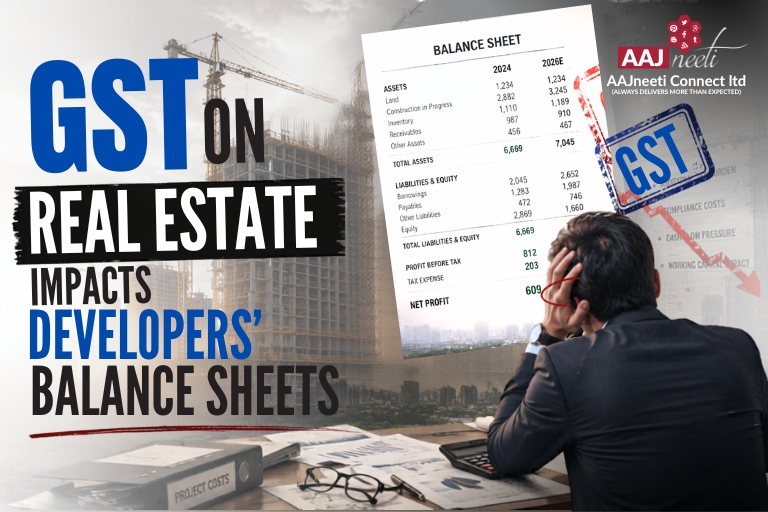
Under the present system, the output tax that homebuyers see looks very attractive, just 5% for standard residential properties and 1% for affordable housing. But here is the catch that trips up the supply chain, developers are completely barred from claiming Input Tax Credit (ITC) on these residential builds.
Every single rupee of tax they pay on steel, labour, electrical systems, and architect fees gets permanently locked inside their construction costs. Even with recent tax updates that cut the cement GST slab from 28% to 18%, that remaining 18% is still an absolute cost that eats into their pocket.
Ultimately, this blocked credit adds a hidden 10% to 12% surcharge to their core construction costs, pulling net margins down by 3.5% to 5.5% across the board. This is one of the biggest ongoing concerns in the GST on Real Estate sector today.
Because builders and developers can’t alter the tax code, the only move available to them is to speed up their sales velocity to lower holding costs and avoid compliance penalties.
The 2026 GST Slabs at a Glance
Let’s see how different properties are treated under the current rules:
| Property Classification | GST Rate | Input Tax Credit (ITC) Status | Key Structural Criteria |
| Affordable Housing | 1% | Completely Blocked | Carpet area up to 60 sq.m. in metros (or 90 sq.m. elsewhere); total cost capped at ₹45 Lakhs. |
| Standard & Luxury Residential | 5% | Completely Blocked | Any residential unit or villa that crosses the affordable housing thresholds. |
| Commercial Property (Offices/Malls) | 12% (Sale) / 18% (Leasing) | Fully Available | Standalone commercial builds. Developers can fully offset input taxes here. |
| Commercial Shops inside a Residential Project | 5% | Completely Blocked | Small retail spaces or kiosks inside a project that is mostly residential (up to 15% of total area). |
| Ready-to-Move Properties | 0% | Not Applicable | Properties sold after receiving an official Occupancy Certificate (OC) or Completion Certificate (CC). |
The Real Story Behind the Cement Tax Reduction
When the government rolled out its streamlined “GST 2.0” framework, it brought down the tax on cement from 28% to 18%. On paper, a 50kg bag became roughly ₹25 cheaper, which sounds great. Tiles, paints, and finishes saw similar drops.
But under the current GST on Real Estate structure, if you are a residential builder and can’t use ITC to write off your procurement expenses against your final sales, that 18% tax on cement remains a sunk cost.
Earlier, when developers paid taxes on raw materials like cement, the government gave them a discount later. When they sold their final product, they got to deduct the tax they already paid from the tax they owed that’s known as Input Tax Credit (ITC). It was a way of making sure businesses don’t get taxed twice.
But for residential builders, the GST on Real Estate system now follows a different rule, no ITC benefits on residential projects.
So, when developers pay that 18% tax to buy cement, structural steel and rebar, paints, finishes and coatings, elevators and substation equipment, and contractual labour and project management, that money is gone forever. They can’t use it to lower their final tax bill. It just gets added straight to their total construction bill as an extra, unrecoverable expense.
Since materials and third-party contracts usually eat up about 60-70% of the developers’ total budget (excluding land cost), their profit margins get squeezed considerably. This hidden cost burden is one of the biggest financial pressures within the GST on Real Estate ecosystem today.
It makes the whole project more expensive to build, and they just have to swallow the cost.
Two Other GST Cash-Flow Traps Developers Struggle With
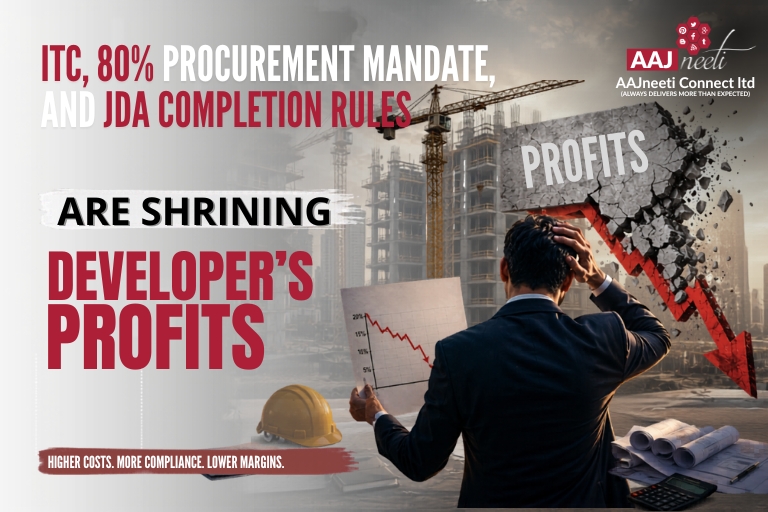
Besides the direct loss of ITC, there are two other administrative compliance checks that were introduced that caught many mid-sized builders by surprise:
The 80% Procurement Mandate
To clean up supply lines and discourage cash-only material suppliers, the tax department requires developers to source at least 80% of their raw materials and building services from registered GST vendors. If their procurement from registered businesses falls short of this 80% limit during a financial year, the consequences are immediate. They are forced to pay a flat 18% tax under the Reverse Charge Mechanism (RCM) on the entire shortfall.
Even worse, if a builder buys cement from an unregistered seller, they can’t wait until the end of the year to settle the tax. They have to pay the full tax under RCM on those purchases on a monthly basis, draining their short-term liquidity.
Joint Development Agreements (JDAs) and the Completion Trap
Since land costs are so high, most modern urban projects are launched as JDAs. The land owner provides the Transfer of Development Rights (TDR) to the developer in exchange for a share of flats or future revenue.
Under the current GST on Real Estate rules, the TDR value is exempt from GST only for the apartments builders manage to sell to homebuyers before they receive their Completion Certificate (CC).
If developers have unsold inventory on the day the CC is issued, that tax exemption disappears proportionally. They have to pay a 5% GST on the value of those unsold units under RCM immediately upon completion. If they finish a project and are sitting on 25% unsold stock, they face an immediate tax bill from the government, locking up cash right when they need it most.
This structure within GST on Real Estate is creating serious cash-flow pressure for developers, especially in large township and high-inventory projects.
Let’s See How GST on Real Estate Impacts a ₹150 Crore Project
While GST slabs might look harmless above, let us see how they play out on an actual balance sheet for a standard mid-to-luxury residential phase in a growing hub like Noida or Gurugram.
- Total Saleable Area: 2,00,000 square feet
- Average Sale Price: ₹7,500 per square foot
- Total Project Revenue: ₹150 Crores
- Land Acquisition Cost: ₹45 Crores
- Base Construction Budget (Materials + Labour): ₹70 Crores
In this case, let us see how the lack of Input Tax Credit (ITC) changes the final profit margins:
- Material & Service Inputs Subject to 18% GST: ₹50 Crores
- Non-Recoverable Input GST Paid (18% of inputs): ₹9 Crores
- Other Exempt/Internal Construction Costs: ₹20 Crores
- Total Adjusted Construction Cost: ₹79 Crores
- Gross Margin Potential (If ITC was fully available): ₹35 Crores (23.3% of revenue)
- Actual Realised Margin (Under Current Non-ITC Rules): ₹26 Crores (17.3% of revenue)
By losing the ability to write off that ₹9 Crores in input taxes, the developer’s profit margin drops from a comfortable 23.3% down to a lean 17.3%. If you combine that with a slow sales cycle, the interest on their construction loans will quickly consume what is left.
Why Does This Issue Concern Brokers and Channel Partners?
When a developer’s margins are compressed, the financial pressure moves quickly down the supply chain, altering how channel partners and real estate brokers operate.
- Milestone-Linked Commissions: Flat, unconditional brokerage percentages are disappearing. Developers are increasingly tying payouts to strict collection milestones, meaning you get paid when the buyer clears their initial construction slabs, not just when a booking form is signed.
- Slower Cash-Flow Cycles: Because builders must constantly manage liquidity to cover monthly RCM payments on raw materials, brokers often experience delays in getting their invoices cleared.
- The Push for Under-Construction Velocity: Because the JDA rules penalise developers for holding unsold stock past the Completion Certificate stage, builders are giving brokers better incentives to sell under-construction inventory rather than ready-to-move-in flats.
How AAJneeti Helps You Protect Your Profit Margins?

We can’t alter the tax slabs for you. But we can help you improve your customer acquisition process. We understand that the most effective way to beat a 5% margin drain is to significantly increase your sales velocity. Also, we can help you sell your inventory during the early, under-construction phases, so that you can:
- Reduce the interest paid on construction finance.
- Maintain a steady cash flow to pay registered vendors on time.
- Completely avoid the post-completion RCM tax on unsold inventory.
We can help you with optimizing your finances by offering you specialised real estate lead generation services.
We don’t deal in raw lead lists with just names and phone numbers. We use behavioural data to find active buyers, corporate professionals, and long-term investors who match your exact price segment and have the intent to buy your product ensuring your sales team only spends time on high-intent prospects.
The rules governing GST on real estate apply to every builder, developer, and broker across the country. The companies that succeed in this environment are not the ones waiting for tax laws to change. They are the ones who adapt their sales and marketing infrastructure to match the current financial reality.
We focus directly on high-velocity, performance-based real estate lead generation services. You can insulate your business from margin compression and protect your profits safely.
Partner with AAJneeti today and protect your margins with a predictable, high-performing sales funnel.